Luminara
Educational Game | 2025 | Team PRISM | Python / Pygame / JavaScript
Luminara is an educational puzzle game that introduces additive RGB color mixing and visual logic through hands-on play. Players act as a “Light Architect,” arranging colored geometric light emitters to recreate projected target shapes. Designed for visually driven learners, the game bridges physics concepts with creative design thinking.
Learning Goal
Many learners intuitively understand paint mixing but struggle with how light behaves differently. Luminara was designed to make additive color logic tangible through spatial manipulation, targeting students who are drawn to art, architecture, and design but may not identify as “STEM-focused.”

Visual Logic
Understand how overlapping and adjacent shapes behave differently, translating spatial relationships into simple logical operations.

Spatial Reasoning
Apply alignment, symmetry, and proportion to reconstruct target forms through precise placement of geometric elements.

Predictive Thinking
Develop the ability to anticipate visual outcomes before revealing results, encouraging reasoning over trial-and-error.

Creative Problem Solving
Approach abstract constraints as design challenges, combining analytical thinking with visual experimentation.

Additive Color Theory
Additive color mixing describes how colored light combines, not by absorbing wavelengths like paint, but by adding light energy together. In Luminara, red, green, and blue light emitters overlap to create new colors (yellow, cyan, magenta) and ultimately white when all three are combined.
Rather than presenting RGB as a formula, Luminara treats it as a spatial interaction system.
-
Each geometric shape acts as an independent light source
-
Color emerges only where light overlaps
-
New colors are not selected—they are produced
This reframes color theory as something the player constructs, not memorizes.
Game Play
Players step into the role of a Light Architect, reconstructing target projections by arranging colored geometric light emitters on a grid. The game emphasizes visual reasoning, spatial logic, and color interaction, letting players explore rather than follow strict instructions.

Dragging shapes and adding colors
-
Select a geometric light emitter (circle, square, triangle)
-
Assign an RGB color
-
Drag it onto the canvas and layer with others
-
Observe how overlap changes color output
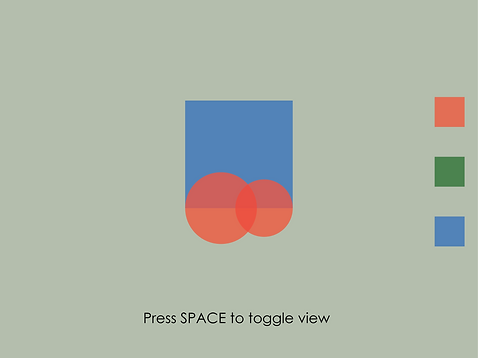
Toggle between normal and projection view
-
Switch between construction (placement) and projection (blended color) views
-
Immediately see the effect of placement and color choices
-
Supports prediction-based learning and visual feedback
UI Prototypes
Prototype 1


Prototype 2